Technologies
Why system instability is rarely a component issue and how interdisciplinary systems architecture ensures predictable innovation.
Resonant piezo systems can often perform reliably in the laboratory yet exhibit unexpected behavior once deployed in use. The underlying cause is seldom a defective component. More often, it is the system’s behavior as an interdependent, coupled whole. When these interdependencies surface only late in development or in the field, a manageable development can quickly turn into reactive cycles of iterative troubleshooting. Adopting a system-level perspective reveals these interdependencies far earlier and establishes the foundation for stable, reproducible, and economically viable solutions.
When Specifications Are Met Yet the System Still Drifts
Even when every component meets its individual design specifications, resonant piezo systems can become unstable. Laboratory conditions typically confirm compliance, but real-world operating environments often trigger a heightened sensitivity.
The interdependencies may also manifest during the development. Adjustments to the mechanics, actuation, or control scheme may resolve an issue in isolation, yet they frequently introduce new, unintended consequences elsewhere. This causes iteration loops that prolong development timelines and push risks downstream into late project phases.
In the vast majority of cases, the root cause is not a single faulty component. Resonant piezo systems do not behave like modular assemblies whose elements can be designed in isolation. The mechanical structure, electrical drive, and control strategy are tightly coupled and continuously influence one another.
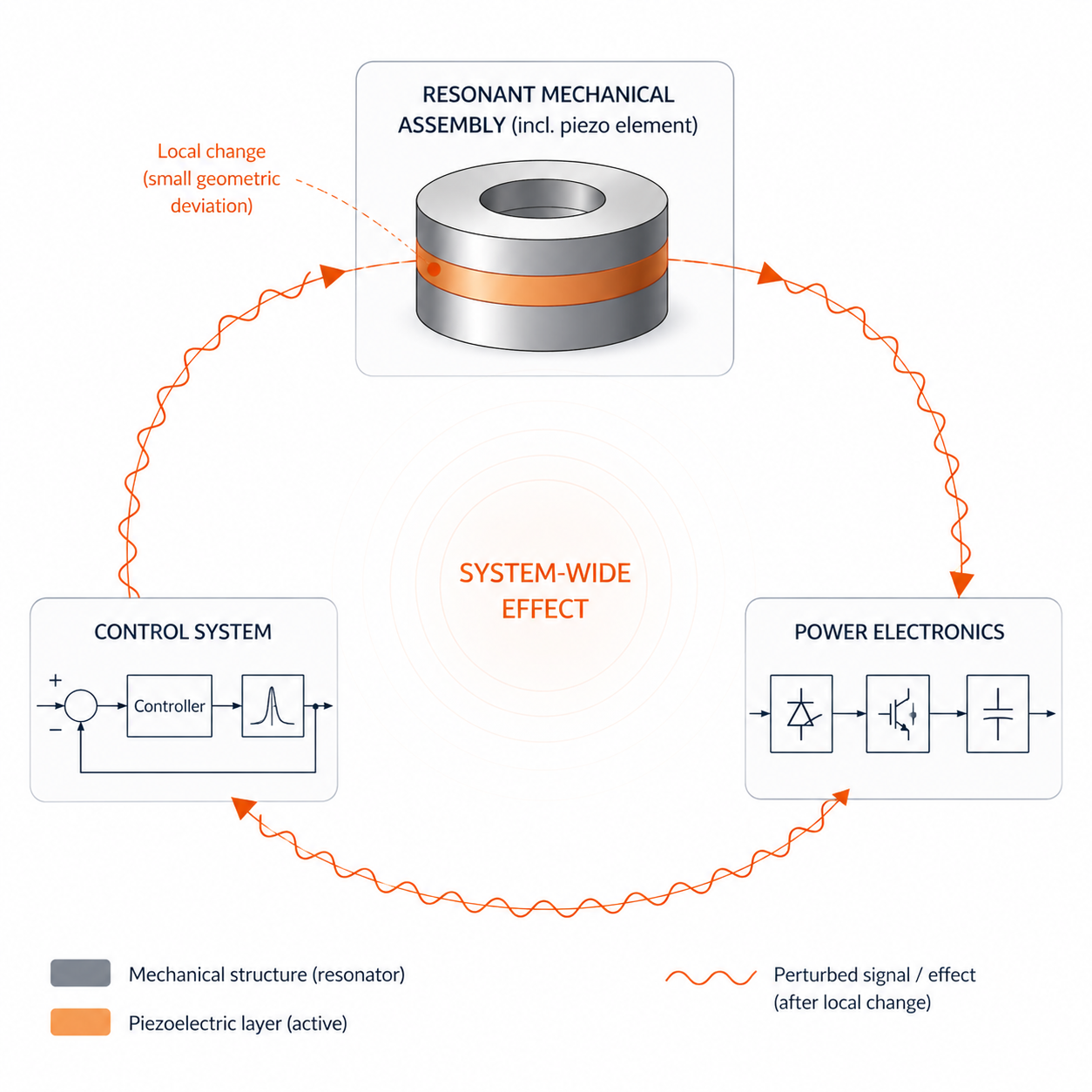
The mechanical design defines the natural frequency. The electrical drive governs amplitude and power. The control system responds to even subtle shifts in behavior. Any modification in one domain propagates throughout the entire system.
Under real world load conditions, these effects intensify. Tolerances, thermal variations, material properties, and installation constraints all contribute to measurable resonance shifts. A system that appears stable in the lab often proves far more sensitive in the field.
In practice, a familiar pattern often unfolds: Mechanical, electrical, and software teams each optimize their respective subsystems. Responsibilities may be clearly delineated. Yet, when the overall system falters, it may be hard to pinpoint the root cause that is distributed over the entire coupled system.
This situation typically arises when system interactions are not adequately addressed from the outset. At this point, the right approach determines whether an innovation reaches the market on schedule or gradually loses momentum.
Coupled Oscillators: Why Minor Deviations Shift the Entire System
The impact of coupling is most evident in system dynamics.
A resonant piezo system can be understood as a chain of coupled oscillators: the control logic, the electrical drive, the piezoelectric transducer, and the mechanical resonator.
Mechanical and electrical oscillations interact directly. A geometric alteration affects not only the mechanical natural frequency but also the electrical impedance. Unless the drive is adjusted accordingly, the system's oscillatory behavior shifts significantly.
A project example underscores this sensitivity. A geometric deviation of roughly 50 micrometers in the resonator caused a measurable shift in resonance frequency. Under laboratory conditions, the effect remained within acceptable limits. Under operating load, however, the system became worryingly unstable.
Only when mechanics, drive, and piezo physics were modelled as a whole, did the dominant relationships become apparent. This insight enabled a targeted mechanical adjustment that stabilized the system in a single iteration, rather than through a whack-a-mole of trials.
These effects are entirely explainable from a physics standpoint but only when the system is treated as an integrated, coupled entity.
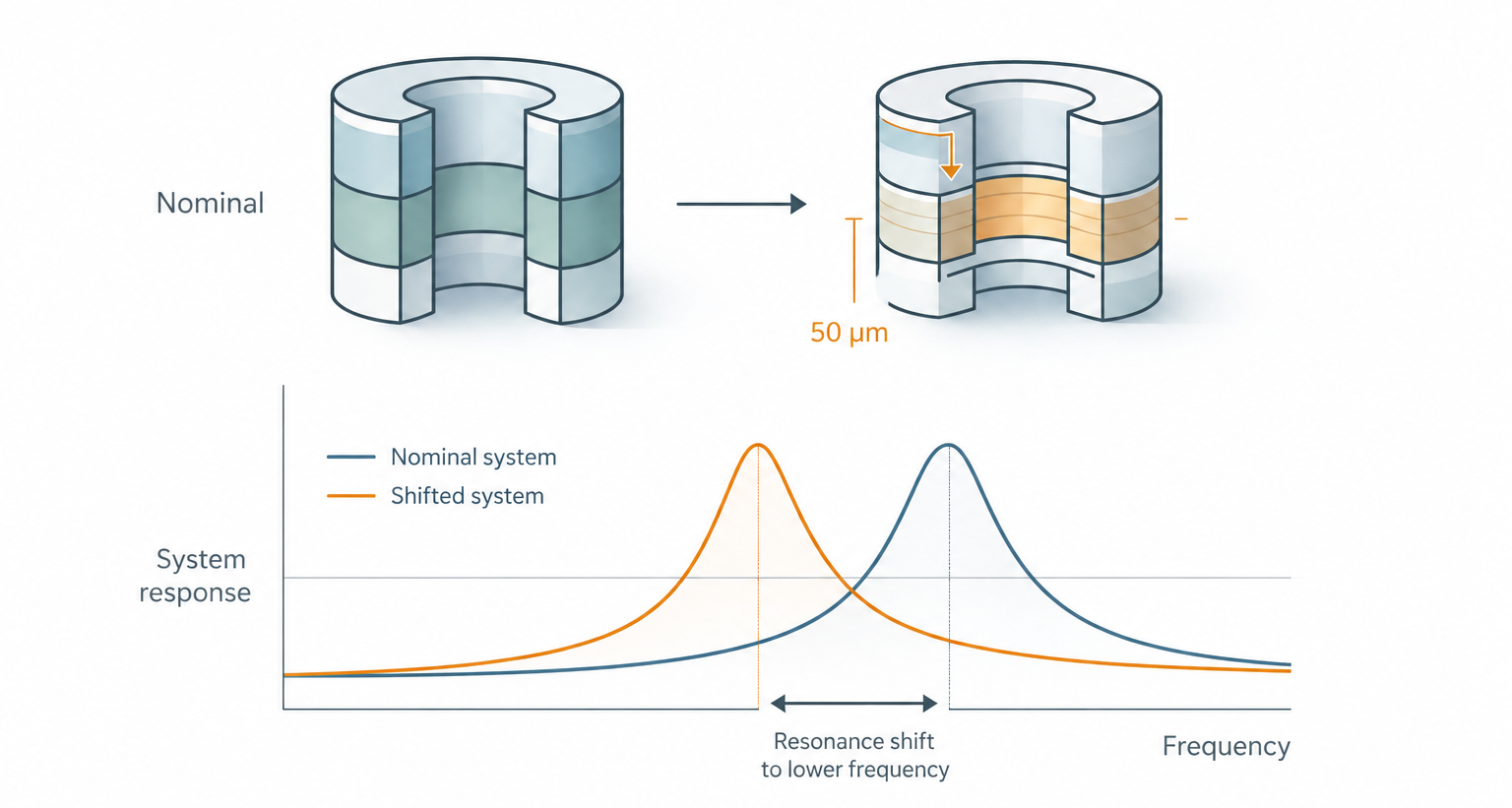
Figure: Helbling
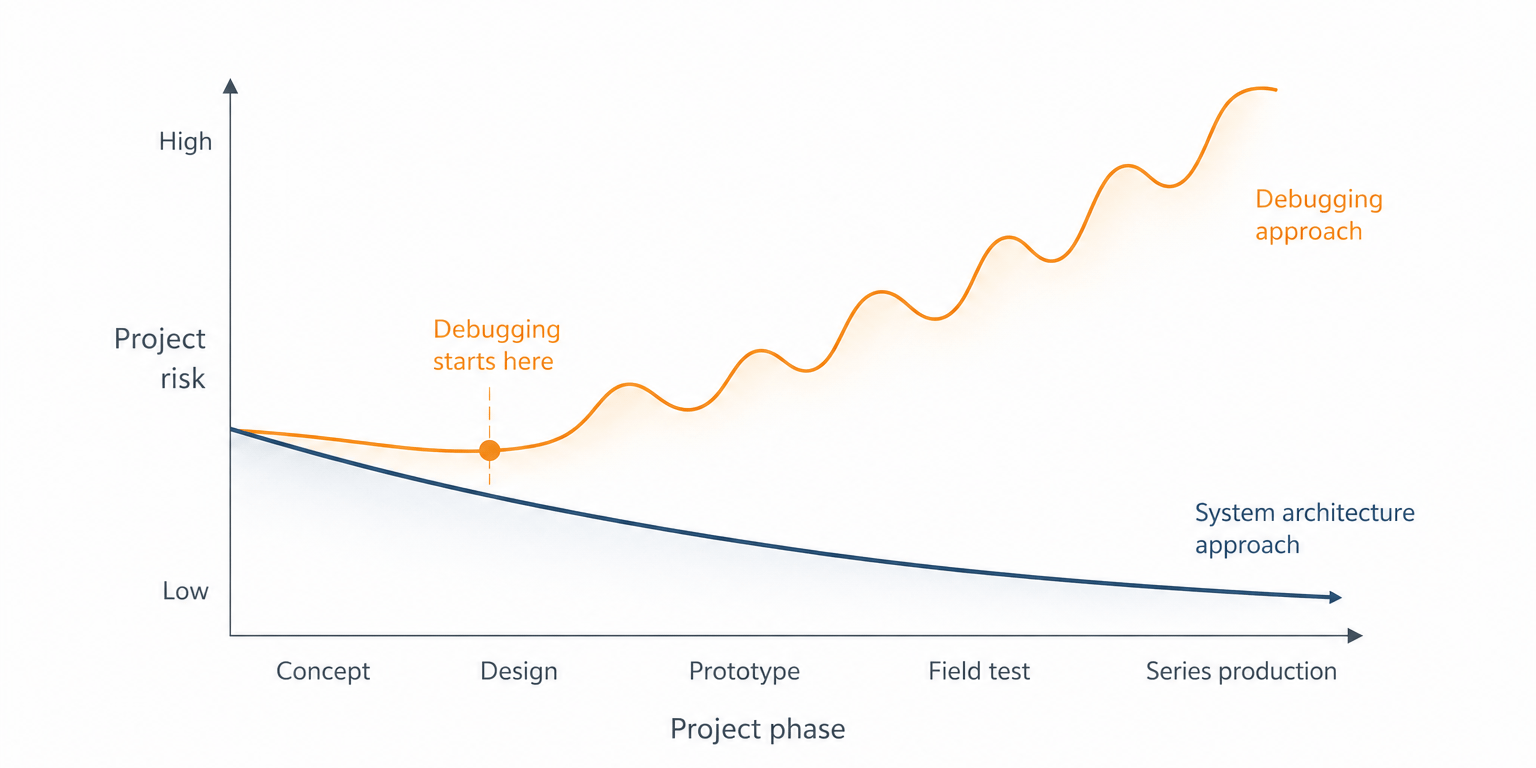
The Turning Point: When Development Becomes Debugging
This raises a crucial question: At what stage is the coupled behavior of the system genuinely understood?
If mechanics, drive, and control are optimized sequentially, critical dependencies are discovered only in later project stages. Instabilities suddenly manifest under real operating conditions.
The later these relationships are identified, the more the corresponding fix shifts into costly phases such as field testing, validation, or production ramp-up. At that point, development becomes reactive.
By then, the implications extend beyond engineering. Changes begin to affect supply chains, regulatory strategies, and production planning. What originates as a physical interaction escalates into a business issue.
A system architecture approach addresses this much earlier. It brings pivotal decisions forward to stages where interactions remain manageable. Dependencies are identified within models and accounted for in design development long before they surface in the field.
This is what distinguishes predictable development from a reactive debugging process.
From Component Focus to System Architecture
A system-oriented approach does not start with selecting a piezo element. It starts with defining the desired effect at the system level:
Which function must be performed reliably under real conditions?
Which boundary conditions influence system behavior?
Which sensitivities affect consistency in production and long-term stability?
Guided by these questions, the system architecture takes shape. Mechanics, piezo physics, electronics, and control are not optimized in isolation but aligned through model-based development.
Numerical simulation can capture both mechanical and electrical behavior. Analytical models describe the dynamic interaction of components. Measurement data validates these relationships under controlled conditions.
The objective is not to optimize individual components. It is to achieve a robust and reproducible system response.
Interdisciplinary Control: Turning Transparency into Command
Reliable system performance is created at the interfaces between disciplines. This is where electrical input translates into mechanical motion. It is also where minor geometric deviations directly influence electrical impedance, thereby affecting coupling and overall behavior.
Interdisciplinary modelling quantifies these relationships. Critical parameters become visible, dependencies are clarified, and system response becomes predictable. Decisions no longer rely on assumptions but build on a robust understanding of system behavior.
For development leads, this approach cuts the number of iteration cycles and sharpens clarity of decisions.
For CTOs, it surfaces technology risks and makes stability margins visible.
For innovation leaders, it helps build momentum around concepts during development.
Herein lies the true differentiation. Not in the mere application of piezo technology, but in the ability to control the system as whole.
Mastering Technology Means Ensuring Predictable Innovation
Whether a system performs reliably in a project and transitions smoothly to production is rarely decided at the component level. It hinges on whether system coupling is managed through appropriate system architecture.
Approaching piezo systems component by component means reacting to complexity as when it is discovered by chance. Grasping system behavior early allows development to be planned and controlled; it enables reliable implementation for real-world constraints.
This shifts the question. It is no longer whether the technology is capable, but whether its behavior has been understood well enough and early enough.
For more than 20 years, Helbling has developed resonant piezo systems across a wide range of applications. This experience informs system architecture that expose critical dependencies early and keep development under control.
This is what enables innovation not only to be conceived but to be planned and realized reliably in practice.
The pivotal question therefore remains: At what point in your development process is system behavior fully understood? This is the watershed between reactive troubleshooting and controlled innovation.
Author: Niklaus Schneeberger
Main Image: Helbling